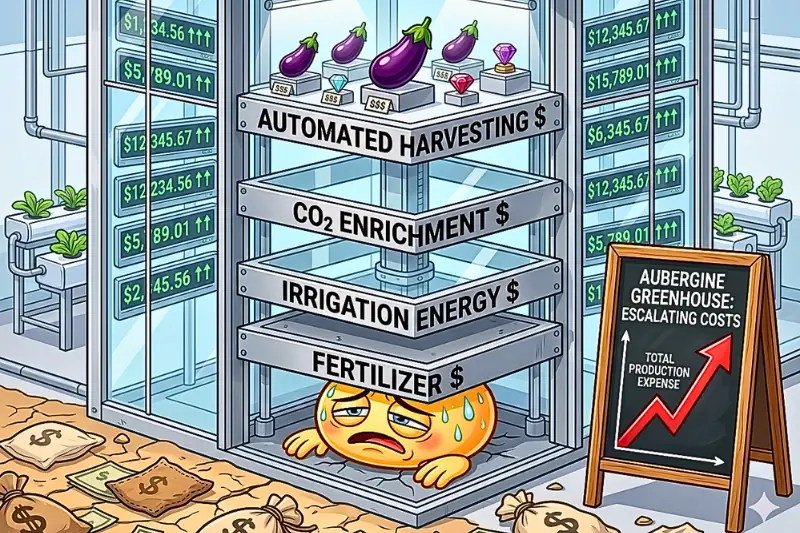
Greenhouse eggplant production cost calculator is the main focus of this page because greenhouse eggplant/aubergine margins often look better on paper than they do in practice.
However, once you add seedlings, substrate, irrigation, fertigation, labor, packaging, transport, and overhead, the real cost per plant and per kg or lb can change quickly.
Therefore, this calculator helps you move beyond rough estimates and build a more realistic profit picture before you set prices, compare scenarios, or expand production.
If you are budgeting outdoor production instead, see our Open Field Eggplant/Aubergine Cost Calculator
Why Greenhouse Eggplant Costs Are Easy To Underestimate
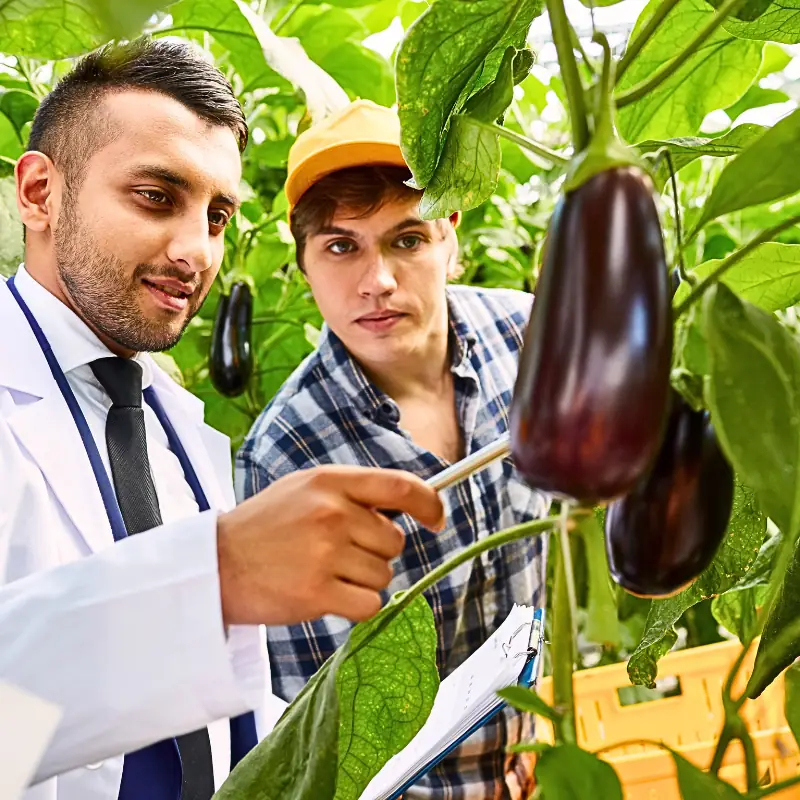
Greenhouse eggplant, or aubergine, can be a profitable crop. However, protected cultivation also introduces several cost layers that many growers do not fully capture at first.
For example, once you include structure depreciation, growing media, fertigation, climate control, crop protection, trellising, repeated harvest labor, and delivery, the margin can look very different from the one you originally expected.
In cooler or less stable climates, aubergines are often best grown under protection, which is one reason greenhouse cost planning matters so much.
As a result, growers who price only from experience or memory often miss their true break-even point.
Where Margins Usually Leak
In many operations, profit does not disappear because of one dramatic mistake. Instead, it often leaks away through smaller undercounted costs. For instance, post-harvest loss, packaging, transport, pollination support, and repetitive crop work can quietly reduce returns over time.
That is why a proper greenhouse eggplant production cost calculator is so useful: it shows how each decision affects the final cost per selling unit, rather than just the total crop spend.
What This Greenhouse Eggplant Production Cost Calculator Covers

This calculator is designed to help growers work through a commercial greenhouse eggplant scenario step by step.
Specifically, it includes production scale, crop profile, structure and site preparation, seedlings, substrate, irrigation and fertigation, fertilizer, climate and energy, crop protection, support systems, harvest handling, packaging, overhead, transport, and final profit outputs.
In addition, it supports different selling units, so you can evaluate your numbers per plant, per kilogram, per pound, or per custom unit.
Because protected cultivation adds more management layers, it helps to think in terms of full greenhouse vegetable good agricultural practices rather than only seed, fertilizer, and selling price.
How To Get More Accurate Results
o get the best value from the tool, enter your own figures as closely as possible. First, start with realistic yield, cycle length, losses, labor, packaging, and selling price assumptions.
Then review the final summary carefully.
After that, adjust one major input at a time and compare the impact. This approach is especially useful for Sustainable farming decisions, Climate-Smart Cultivation planning, and commercial Vegetable gardening where even small cost differences can materially affect profit.
Who This Calculator Is Best For
This calculator is useful for commercial growers, greenhouse managers, consultants, and serious planners who need a clearer view of production economics before making decisions.
It is also valuable for growers testing new varieties, packaging formats, or delivery models. In addition, it fits well within a broader workflow that includes Plant/Soil health planning, AgTech innovations, and more disciplined cost control under protected cultivation.
As a result, it can support both day-to-day budgeting and longer-term business planning.
Step 1: Production Scale & Selling Unit (Covered)
Step 2: Structure & Site Preparation (Covered)
Step 3: Transplants / Seedlings (Covered)
Transplant Details
Step 3B: Growing Media / Substrate (Covered)
Step 4: Irrigation & Fertigation (Covered)
Step 5: Fertilizer & Nutrient Costs (Covered)
Step 6: Climate Control & Energy (Covered)
Step 7: Pest & Disease Management (Covered)
Step 8: Support Systems & Crop Work (Covered)
Step 8B: Pollination & Fruit Set (Covered)
Step 9: Harvest Labor & Post-Harvest Loss (Covered)
A. Pickers & Labor
Sorting & Grading Labor (Packhouse / Shed)
C. Post-Harvest Loss Override
Step 10: Packaging Materials & Retail Presentation (Covered)
A. Simple Per-Unit Packaging Cost
B. Additional Packing Materials
Step 11: Overhead & Farm-Level Fixed Costs (Covered)
A. Land Costs
B. Insurance
C. Certification, Audits & Lab Tests
D. Other Administrative / Overhead Costs
E. Financing / Interest Costs
Step 12: Transport & Delivery Costs (Covered)
Step 13: Final Summary & Export
Cost Breakdown
Labor Burden / Employer Contributions
| Component | Total Cost | % of Total | Cost per Unit | Visual |
|---|
Cost Breakdown – Pie Chart
Markup & Selling Price
Baseline Cost per Unit:
Selling Price per Unit:
Profit per Unit:
Profit Margin %:
Total Profit (Entire Crop):
Eggplant/Aubergine Market “What‑If” Layer
Eggplant/Aubergine Grade & Quality Mix
Save & Export Results
Help
Calculate Your Delivery Distance
Production cost is only part of the story. If you deliver to a processor, wholesaler, fresh market, or supermarket, distance affects fuel, time, labor, and scheduling.
👉 Use Google Maps: https://www.google.com/maps to check the real travel distance to your buyer and treat delivery as part of the margin discussion, not as an afterthought.

Do eggplants grow well in a greenhouse?
Yes. Eggplants usually perform very well in a greenhouse because they prefer steady warmth, strong light, and protection from cold winds. In cooler climates, greenhouse production often improves fruit set, yield consistency, and crop quality.
Why won’t my eggplants bear fruit in a greenhouse?
The most common reasons are poor pollination, temperature stress, inconsistent watering, or weak plant growth. In a greenhouse, flowers may open well but still fail to set fruit if the air is too still, too humid, too cool, or too hot.
Do I need to hand pollinate eggplants in a greenhouse?
Not always, but it can help. Eggplants are self-pollinating, yet greenhouse fruit set often improves when flowers are lightly vibrated by airflow, manual shaking, or a pollination tool, especially when insect activity is low.
Should greenhouse eggplant plants be pruned or trellised?
Yes, in most greenhouse systems they benefit from support and light pruning. Trellising helps prevent stem breakage, improves airflow, and keeps fruit cleaner, while selective pruning can make harvest and crop management easier.
How often should I water greenhouse eggplants?
Watering depends on temperature, plant size, substrate, and fruit load, so there is no single fixed schedule. However, greenhouse eggplants usually need steady moisture with good drainage, because swings between too dry and too wet can reduce fruit quality and increase flower drop.
How many eggplants can one plant produce?
That depends on variety, climate, pruning system, and crop duration. Under good greenhouse management, a healthy plant can produce many harvestable fruits over time, especially when nutrition, pollination, and harvesting are well managed.
How do I know when greenhouse eggplant is ready to pick?
Harvest when the fruit has reached the expected size for the variety, the skin is glossy, and the flesh still feels firm. If fruit is left too long on the plant, it can become dull, seedy, and less marketable.
Can I grow eggplant during winter in South Africa?
It depends on local temperatures and whether you are using protected cultivation. In milder areas, greenhouse production may continue with careful management, but cold nights can still slow growth, reduce fruit set, and increase risk if the structure is not warm enough.
How do I control whiteflies on greenhouse eggplants?
Start with regular crop inspection, early removal of heavily infested leaves, good airflow, and strong sanitation. If pressure increases, combine monitoring with an appropriate control program, because whiteflies can weaken plants, reduce quality, and spread problems quickly in protected crops.
Is eggplant farming profitable in Southern Africa?
It can be, but profitability depends on yield, market access, labor efficiency, input costs, and the price you actually receive. That is why using a crop-specific cost calculator is useful: it helps you compare production cost, selling price, and likely profit before scaling up.