Why This Open-Field Cannabis Cost Calculator Exists
If you’re searching for an open-field cannabis cost calculator, you’re probably tired of guessing your real break-even. Outdoor production can look “cheap” on paper.
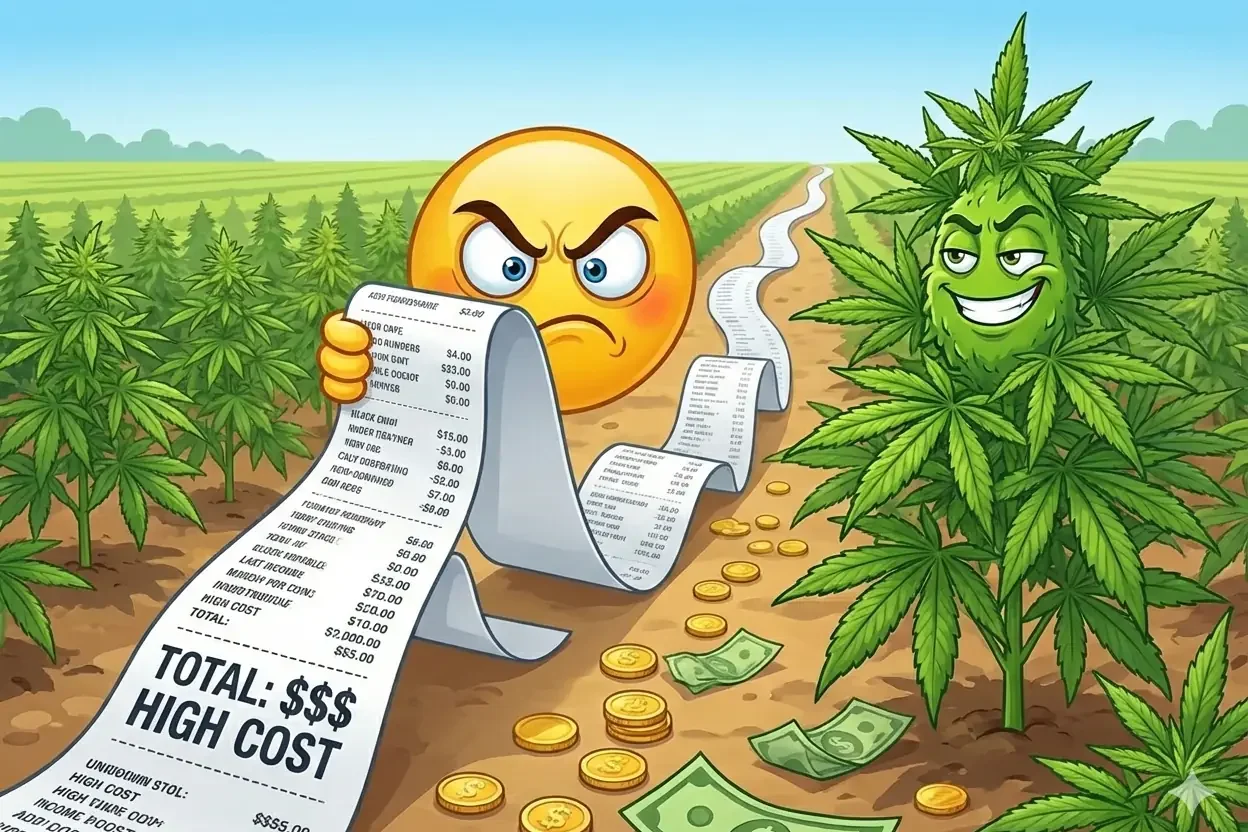
Yet once you add labor peaks, yield losses, drying bottlenecks, and packaging, margins can vanish fast. That’s why I built this calculator to turn outdoor cannabis into clear unit economics you can actually price from.
What You’ll See in Minutes (Even If You’re Busy)
This tool is designed for fast decisions. First, it converts your season into a cost per selling unit (g/oz/kg/lb or a custom pack), so you can compare offers and stop underpricing.
Then, it summarizes what’s driving the bill with a cost breakdown table and visual chart, which makes “hidden” cost creep obvious.
Quick Start vs Advanced: Pick Your Workflow
If you want speed, switch Workflow Mode to Quick Start, which hides the detailed input steps (2–7) so you can price faster.
However, those hidden steps still count in totals using your saved values, so you don’t lose accuracy. If you want full control, stay on Advanced and edit everything step-by-step.
The “Money View”: Break-Even, Markup, and Reality Checks
Outdoor pricing gets messy because markets swing, and costs don’t. So, Step 12 brings it back to basics: break-even reference, selling price with markup options, and profit per unit.
After that, you can export a CSV for your records, and you can also export/import settings as a JSON snapshot to reuse next season with minimal updates.
Post-Harvest and IPM References (Protect Yield and Quality)
Because post-harvest mistakes can destroy outdoor margins, it helps to align your plan with proven drying and handling guidance. For example, NC State Extension covers harvest timing and drying risk factors for hemp flower systems.
Oregon State University Extension also summarizes post-harvest processing considerations that matter when you’re trying to protect quality and avoid mold losses.
And since field pressure is real, Cornell’s hemp insect management resources are a solid reminder that scouting and identification are part of protecting yield (and therefore your unit cost).
If you are looking for other open field cost calculations, here are our other field calculators for tomato, pepper and cucumber production.
Step 1: Define Your Production Scale & Selling Unit
Step 2: Land Preparation Costs
Step 3: Planting Material & Propagation
Transplant Details
Step 4: Irrigation System Costs
Irrigation Systems
Step 5: Fertilizer & Nutrient Costs
Step 6: Pest and Disease Management
Step 7: Support System Costs
Step 8: Harvest Labor Costs
A. Pickers & Labor
Optional: Harvest schedule helper (Cannabis)
Open-field cannabis is often harvested in one main window — but labor can still stretch across days/weeks (blocks, staggered fields, wet weather delays). Use this helper to estimate Number of Harvest Days. You can still type your own total harvest days if you already track it.
B. Field Sorting & Grading Labor
C. Trimming & Bucking (Optional)
D. Post-Harvest Loss Override
Step 9: Post-Harvest Supplies & Packaging
A. Simple Per-Unit Packaging Cost
B. Additional Packing Materials
C. Testing & Quality Assurance (Optional)
D. Drying & Curing (Optional)
Step 10: Overhead & Farm-Level Fixed Costs
A. Land Costs
B. Licensing & Compliance
C. Security & Surveillance
D. Insurance
E. Certification, Audits & Lab Tests
F. Other Administrative / Overhead Costs
G. Financing / Interest Costs
H. Contingency / Risk Reserve (optional)
Step 11: Transport & Delivery Costs
Step 12: Final Summary & Export
Cost Breakdown
| Component | Total Cost | % of Total | Cost per Unit | Visual |
|---|
Cost Breakdown – Pie Chart
Markup & Selling Price
Baseline Cost per Unit:
Selling Price per Unit:
Profit per Unit:
Profit Margin %:
Total Profit (Entire Crop):
Cannabis Market Scenarios
Save & Export Results
Help
Calculate Your Delivery Distance Before Pricing Your Cannabis
Not sure how far your customer is from your farm? No problem. Before setting your delivery cost in the calculator, you can quickly check the exact distance using Google Maps. Simply enter your farm location and your customer’s address to estimate kilometers or miles accurately.
👉 Use Google Maps: https://www.google.com/maps

How many cannabis plants can you grow per acre outdoors?
Plant count per acre depends on your spacing plan, equipment access (walkways, irrigation lanes, harvest routes), expected plant size, airflow needs, and local compliance limits (where applicable).
For budgeting, treat plant density as a “design choice” that drives everything else in the calculator: transplant counts, irrigation volume, labor, inputs, and expected yield.
What’s the spacing between plants?
Outdoor spacing is a balance between canopy size, sunlight interception, airflow (disease pressure), and how you’ll manage the crop (hand-worked vs. mechanized tasks).
If your goal is Climate-Smart Cultivation, plan spacing around risk reduction: better airflow and access usually lowers losses and improves consistency—even if it slightly reduces plant count.
How many dried pounds per acre should I expect to produce?
Per-acre yield is shaped by genetics, plant density, season length, nutrition and water consistency, pest/disease pressure, and post-harvest handling (losses can be significant).
For cost planning, it’s smarter to model a realistic range (low/expected/high) so your price and break-even don’t rely on a single optimistic number.
Is it necessary to start with seeds or clones outdoors?
Seeds and clones each change your risk profile and your cost structure. Seeds can be simpler logistically and diversify genetics, while clones can improve uniformity (timing, plant structure, harvest window).
In the calculator, this choice affects propagation costs, failure rates, labor planning, and how predictable your harvest is.
Should I use feminized seeds for my outdoor grow?
Feminized seeds can reduce the risk of ending up with unwanted male plants, which can protect yield and quality—especially when you’re cost-modeling a defined plant count. The tradeoff is usually cost and sourcing reliability.
If your focus is Sustainable farming and predictable outcomes, the “more uniform inputs” path often makes planning cleaner.
How long does it take to grow cannabis outdoors from seed to harvest?
Timing varies widely by genetics and local season conditions, but the key planning point is this: outdoor production is seasonal and schedule-driven.
Use the calculator to map costs across phases (setup → vegetative care → flowering risk period → harvest → drying/curing) so you can see when cash and labor demand spikes.
What’s a good soil to start in?
Prioritize plant/soil health basics: drainage, structure, stability, and a nutrient plan you can manage consistently.
Many growers succeed by focusing less on “brand soil” and more on proven soil principles—building fertility gradually (often aligned with Regenerative Agriculture) and avoiding extremes that create stress and inconsistency.
Is it better to plant in the ground or in pots outdoors?
In-ground growing can support larger root systems and long-term soil improvement (a regenerative pathway), while containers can offer control and flexibility (especially if you need mobility, security, or tighter management).
For cost modeling, containers typically raise media and watering costs, while in-ground systems often increase site prep and soil conditioning costs.
Can I move my indoor cannabis plants outdoors mid-grow?
It’s possible, but the major risk is transition stress (light intensity, wind, temperature swings) and the management complexity that follows.
For planning, treat it as a higher-variability scenario—your inputs and labor can increase because consistency is harder to maintain.
How do I get rid of aphids on my marijuana plants?
Use an IPM mindset: confirm identification, monitor pressure over time, and prioritize lowest-impact controls first—especially if you’re targeting Organic farming or residue-sensitive markets.
Build prevention into your budget (scouting labor, beneficial habitat, sanitation, and compliant interventions) because reacting late is usually the expensive path.
How can I prevent powdery mildew or bud rot in outdoor cannabis plants?
Outdoor disease pressure is driven by microclimate (humidity pockets, poor airflow, wet canopies) and timing (weather during flowering).
In a calculator context, plan for prevention costs—canopy management labor, monitoring, and compliant controls—because the “cost of loss” (reduced yield/quality) is often bigger than the cost of prevention.
Do you need a license to grow medicinal cannabis for commercial purposes, and where do you apply?
In many jurisdictions, commercial cultivation requires licensing, approved sourcing, record-keeping, and sometimes testing/traceability.
Because rules vary, the safest approach is to treat compliance as a dedicated cost line (applications, renewals, security requirements, audits, testing) and confirm specifics with the relevant regulator or licensing authority where you operate.